D3-1. Magnetic Fields and Force on a Conductor
1. Right-Hand Grip Rules
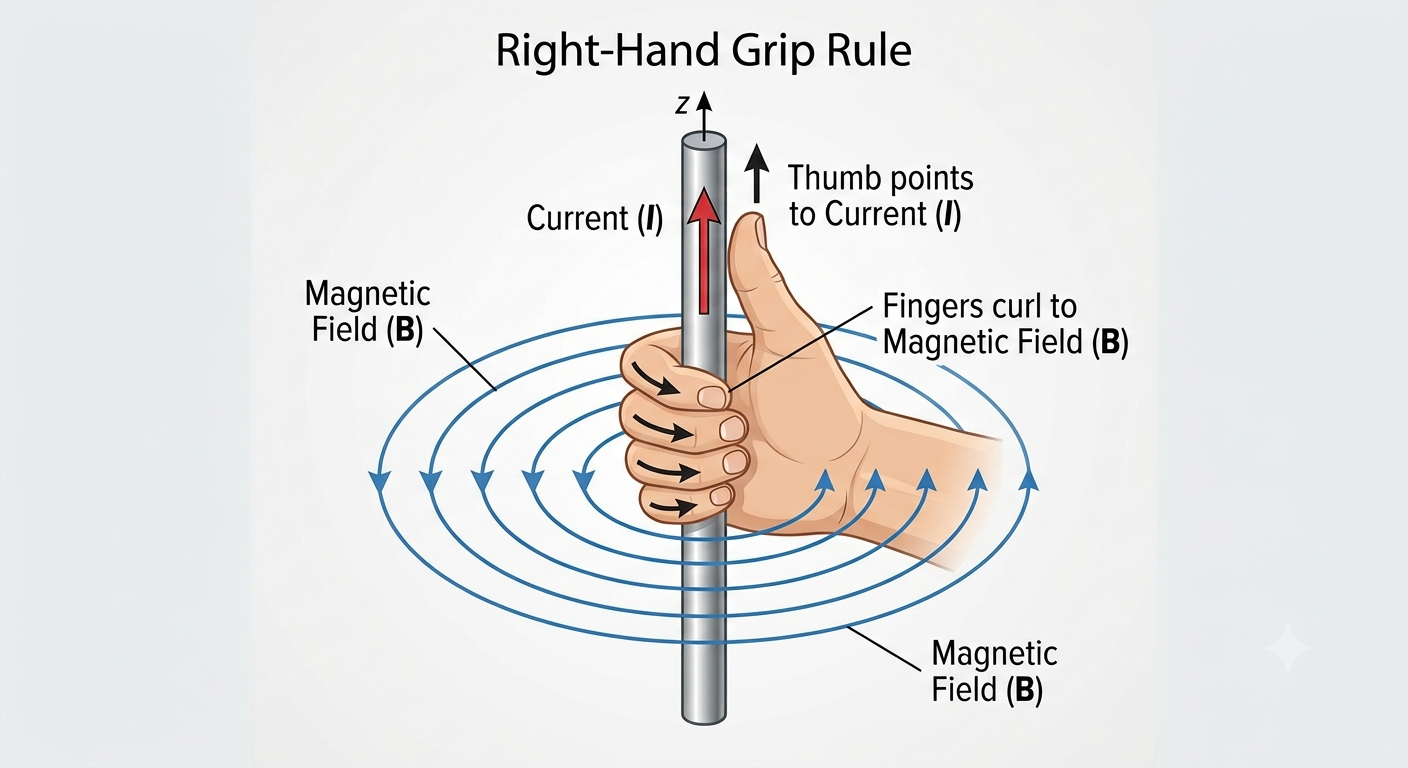
Straight Current-Carrying Wire
- Magnetic field lines form concentric circles centered on the wire.
- The lines are closer together near the wire (stronger field) and further apart away from it (weaker field). The magnetic field strength ($B$) is directly proportional to the current ($I$) and inversely proportional to the radial distance from the wire.
- Right-Hand Grip Rule: Point your right thumb in the direction of the current. Your curled fingers show the direction of the magnetic field ($\vec{B}$).
- Note: Conventional current flows from positive to negative. If you are tracking electron flow (negative to positive), you must use your left hand to get the correct field direction.
Flat Circular Coils & Solenoids
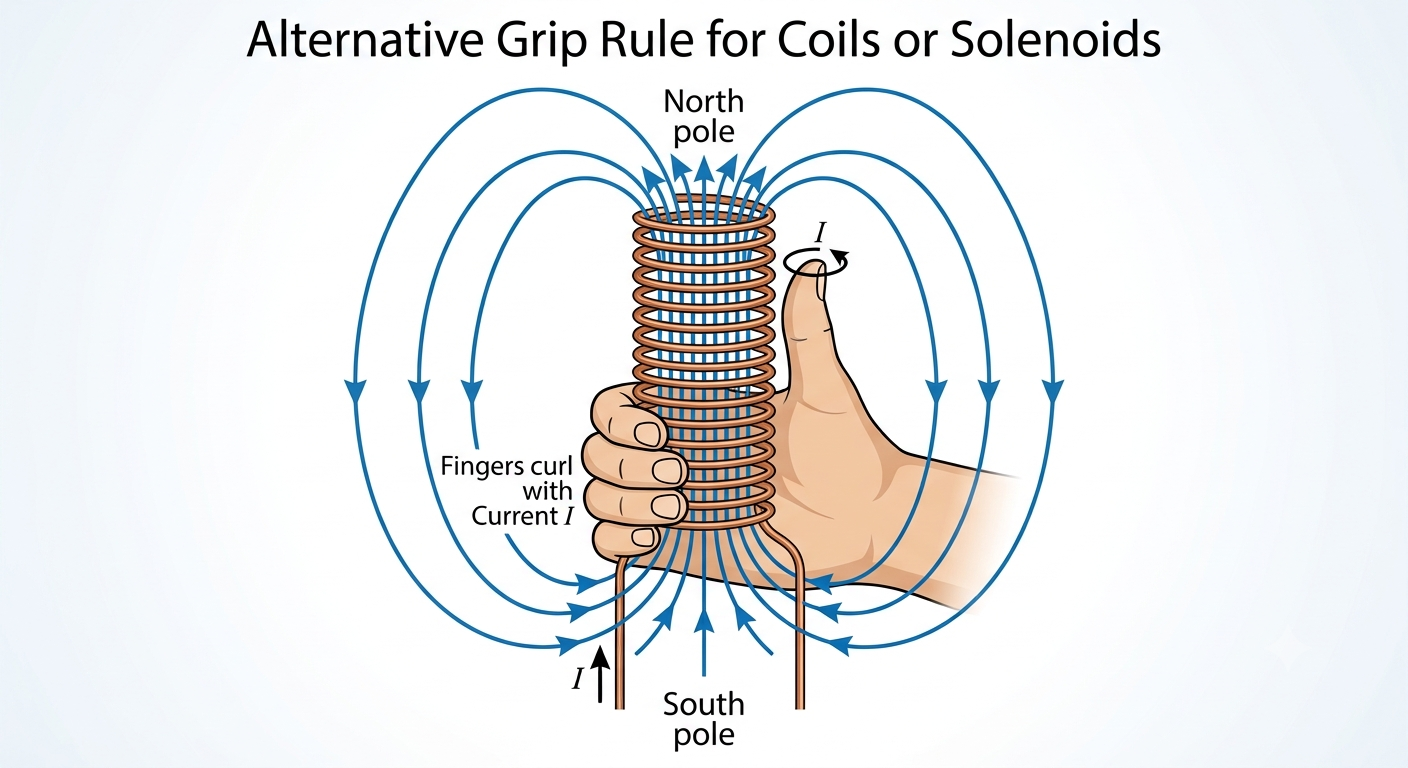
- The magnetic field of a coil or solenoid is mathematically and visually similar to a bar magnet.
- The field lines are straight and highly concentrated through the center, but diverge and curve around the outside.
- Uniform Interior Field: Inside a tightly wound, ideal solenoid, the magnetic field is uniform (constant strength and direction). The strength increases with higher current or a higher density of coils (turns per unit length).
- Core Amplification: Placing a ferromagnetic material (like an iron core) inside the solenoid will greatly amplify the overall magnetic field strength by aligning the magnetic domains within the iron.
- Alternate Grip Rule: Curl your right fingers along the direction of the current loop. Your thumb will point towards the North pole of the induced magnetic field.
2. Magnetic Field Properties & The Lorentz Force
The Formula
- Calculates the magnetic force on a moving charge or current-carrying wire.
- Direction: Due to the cross product ($\times$), the magnetic force is always perpendicular ($\perp$) to the plane formed by the velocity/current vector and the magnetic field vector.
- Maximum/Minimum: Force is maximum when $\theta = 90^\circ$ (perpendicular intersection) and zero when $\theta = 0^\circ$ (moving parallel to the field lines). Magnetic fields exert no force on stationary charges ($v = 0$).
- Circular Motion: Because the Lorentz force is always perpendicular to velocity, it does no work on the charge (cannot change its speed or kinetic energy). Instead, it acts as a centripetal force, forcing the particle into uniform circular motion.
Notation Key & Units:
- $F$ = Magnetic force ($\text{N}$)
- $q$ = Charge ($\text{C}$)
- $I$ = Current ($\text{A}$)
- $v$ = Velocity ($\text{m s}^{-1}$)
- $L$ = Length of wire inside the field ($\text{m}$)
- $B$ = Magnetic field strength ($\text{Tesla, T}$)
- $\theta$ = Angle between $\vec{v}$ (or $\vec{L}$) and $\vec{B}$
Field Properties in 3D:
- Field lines always point from the north pole (N) to the south pole (S) outside of a magnet.
- Dots: represent the magnetic field directed out of the plane of the page (think of an arrow's tip coming toward you).
- Crosses: represent the magnetic field directed into the plane of the page (think of an arrow's tail feathers moving away from you).
The Open Palm Right-Hand Rule
- This rule allows you to quickly determine the direction of the resulting magnetic force in 3D space.
- Fingers: Point them straight in the direction of the magnetic field ($\vec{B}$).
- Thumb: Point it in the direction of the velocity ($\vec{v}$) of a positive charge, or conventional current ($I$).
- Palm: The direction your palm faces is the direction of the resulting magnetic push/force ($\vec{F}$).
- Critical Exception: If the particle is negatively charged (like an electron), the force acts in the exact opposite direction. You can either use your left hand instead, or use your right hand and flip the final result 180 degrees (e.g., if palm faces "Up", the actual force is "Down").

3. Examples
Example 1
Problem A positively-charged particle moves parallel to a wire that carries a current upwards.
What is the direction of the magnetic force on the particle?
A. To the left
B. To the right
C. Into the page
D. Out of the page
Solution:
By the Right-Hand Grip rule, the wire creates a magnetic field that is pointing into the page on the right side where the particle is. Applying the Open Palm Right-Hand Rule for a positive charge moving upwards in a field pointing into the page, the resulting force is to the left (towards the wire). The answer is A.
Example 2
Problem A wire carrying a current $I$ is placed in a region of uniform magnetic field $B$, as shown in the diagram.
The direction of the field $B$ is out of the page, and the length of the wire is $L$. What is correct about the direction and magnitude of the force acting on the wire?
| Direction | Magnitude | |
|---|---|---|
| A. | $\searrow$ | equal to $BIL$ |
| B. | $\searrow$ | smaller than $BIL$ |
| C. | $\nearrow$ | equal to $BIL$ |
| D. | $\nearrow$ | smaller than $BIL$ |
Solution:
1. Magnitude: Even though the wire is slanted on the 2D plane of the page, the uniform magnetic field ($B$) is pointing directly out of the page. This means the angle ($\theta$) between the current direction and the magnetic field lines in 3D space is exactly $90^\circ$. Using the magnetic force formula $F = BIL\sin\theta$, we get $F = BIL\sin(90^\circ) = BIL$. Therefore, the magnitude is exactly equal to $BIL$.
2. Direction: Apply the Open Palm Right-Hand Rule. Point your outstretched fingers directly toward your face (representing the $B$ field coming out of the page). Orient your thumb so it points diagonally up and to the right (representing the current $I$). Your palm will naturally face diagonally down and to the right ($\searrow$), pushing perpendicular to the wire itself. This represents the direction of the magnetic force.
The correct combination is direction $\searrow$ and magnitude equal to $BIL$. The answer is A.